Wednesday, October 31, 2012
Spoiler Alert! Jimmy and The Giant Supermarket
Tomorrow night is the Australian (free tv) screening of Jimmy and the Giant Supermarket on SBS.
8:35 Jimmy And The Giant Supermarket
"Meatballs - Rare breed pig farmer Jimmy Doherty goes inside Britain's biggest supermarket, Tesco, to come up with innovative ideas to produce equally cheap but higher-welfare alternatives to their best-selling meat products. In the first episode, Jimmy tries to transform Tesco's own brand meatballs. In doing so, he spots an opportunity to tackle one of dairy farming's biggest secrets - the killing each year of tens of thousands of male dairy calves because there's no market for them. (From the UK) (Documentary Series) (Part 1 of 3) PG CC"
This guy has had a number of shows back in the UK… and as he is a ‘celebrity’ rare breed pig farmer, I am keen to see how he is as a host. (www.jimmysfarm.co.uk)
As for the subject, the idea that the supermarkets own brand products can be ethically produced for the same price is AWESOME! I’m not saying it wouldn’t be a challenge, but Tesco has agreed that it will adopt these if it can be done.
Now Tesco have been involved with a few innovative products /TV series- good PR, yes. But why not? To be fair the UK market is far more competitive than here (well Nth QLD at least). So I guess the saying any publicity is good publicity works. As Tesco remain the UK’s largest market share.
I have to admit, I have read what this ‘opportunity’ is that they have mentioned. And its not a new concept and he’s not the first celebrity foodie to promote it. Personally I use the same sort of principle at our place when it come to producing chickens for laying and then chickens for consumption… meat.
There are many out there that fail to realise that to produce milk, a cow need to have a calf. Much like any other mammal.
Now female calves, being girls, will obviously be of use to a dairy farmer in their future years. Or be viable resource for sale, so are raised as such. Males on the other hand, are not useful to a dairy farmer; who in all honesty is paid to produce a product. A product that they are required to share with the caves. So to achieve the greatest output possible male calves are culled. They offer no value to the farmer, for sale or stock and deplete the milk stores.
Similar process happens in many hatcheries (producing laying birds). Roosters (cockerels) are not of use and therefore would decrease profits to feed. So most are killed, once sorted from day old.
We made a decision when we begun breeding our flock that males would be grown for meat or sale, regardless of their breed. Obviously certain breeds make better table stock than others, but chicken is chicken.
I have often wondered how much ‘potential meat’ is lost through modern practices. I mean raising produced based on type, species or breed of animal for its ideal purpose makes sense. But on the other hand, what about anything that is produced as a subsequence that doesn’t quite fit the brief.
I mean the potentials such as ‘pink veal’ of dairy billy calves (told you this was a spoiler) and the roosters from hen hatcheries. But can we go further? What about the chickens produced for meat sales that do not make their weight targets? It is common practices for birds that are below weight, by a set time scale to be culled… I have often thought that whilst they will not make the desired weight for roast chickens or whole chickens on the supermarket self. Surely they could serve some viable purpose. I understand whilst the farmer may not wish to feed it further, as it would be literally eating into its profits. But that bird still carries a food source suitable for other chicken products or uses. Just discarding that life as it doesn’t meet a standard and timescale appears pointless!
The issue with my theory that these deaths should be utilised is that the farmer may not have a contact for such produce. And as this source is based on stock not meeting a standard, you can not guarantee supply, how could they? They may not be able to provide to another buyer, contractually. Furthermore, they have to transport that animal to slaughter, separate it and transport it elsewhere. So I am far from blaming the farmer for making a living. I guess I am merely pointing out that there are flaws in many of today’s practices, other than the obvious animal welfare conditions that often get discussed. Many farmer would like to farm more ‘ethically’, but it is’t financially viable. And not many have an ‘innovative’ foodie, backed by a large supermarket chain offering cash for diversifying into their bi-products.
But there are ‘opportunities’ out there. I guess much of the problem is our expectations and preconceptions as consumers.
I often get frustrated with people who will only eat certain cuts of meat; the popular ones, such as chicken breasts or certain chops or ‘the best steaks’… Well guess what? An animal was killed for that particular part. So by all means appreciate the cut and enjoy it, but have the decency to appreciate an animal was responsible for producing that. So subsequently it also produced less popular cuts. How many people turn their noses up at offal? It was a standard meal to my grandparents.
Don’t get me wrong there are bits I have tried, which I have little interest in eating again. Like chicken feet and pig’s ears. But they are viable protein sources and should not be knocked. I admit with our birds, chicken feet are either fed to the dogs (as a treats for days to come), or I was delighted when a work colleague asked Matt if we could save the feet for his father in future. I was happy to oblige and he apparently serves up an awesome Yum cha.
And I am not necessarily just discussing meat. Does it not strike you as strange that an apple or a capsicum (pepper) in Woolworths or Coles (Asda or Tesco) look significantly more pristine than those at your local greengrocer, farmers market or local veg stall. I am not saying they are inferior, quite the reverse. I mean the stuff I grow in my garden has far more lumps and bumps than the supermarket produce does. And I know this is not that they are far more competent growers than I am (even if that is probably true). Also I have far more exciting varieties of fruit and veg, that you just don’t see on the supermarket shelves.
It seems ridiculous that so many people are struggling to put food on the table and farmers are struggling to get a decent price for their stock, when perfectly good potential food is going to waste.
Am still looking forward to watching the show. How about you?
Labels:
beef,
chicken,
food for thought,
food source,
meateaters responsibility,
pork,
veggies
Tuesday, October 30, 2012
Food for fuel? Food for thought? Or a ‘fat tax’
A friend of mine posted a report on Facebook yesterday discussing how obesity is now Australia’s and the world biggest killer. Now affecting 2 out of 3 adults and 1 in five children 2 -4 years. http://www.news.com.au/lifestyle/health-fitness/australias-obesity-crisis-worsens-as-survey-shows-two-out-of-three-adults-overweight-or-obese/story-fneuz9ev-1226505251354 . One of the suggestions put forward by this Facebook debate, was a Medicare levy dependent upon your weight or physical health. (Medicare is the Australia national health care service, similar to NHS in the UK only it only covers a percentage of treatments and doctors visits etc). Others are suggesting a tax on convenience food or treats… would this really drive people to be healthy. Well it sparked a debate, some for, many against. Others such as myself can appreciate the idea, but can see the many flaws this may create. I mean its been tried on cigarettes and alcohol in most countries. And the loop wholes of a physical could be exploited by many.
Now I know what you’re thinking, this is a strange subject for a smallholding, home farm lifestyle blog, not really on point. And in some respects your right. But that discussion got me thinking about the many reasons we have made the lifestyle choice we have. And has inspired me to revisit my first ever blog ‘Just for the taste… not the waist’ http://just4thetaste.blogspot.com.au/ . But to not just revisit it and update it to reflect how far my journey has come. As this is a subject I (much like food sourcing and animal conditions) I can talk about forever! As for those who know me, would already know this is a very personal issue, as I myself, struggle with my weight. Though I am and continue to aim to control it through a combination of better food choices and exercise.
Exercise being a vital part of ‘good health’, and I do not believe that addressing either food or exercise will be truly successful for long term health- not just weight. It has to be both. And exercise is not something I really discuss on here. But I believe the trick is finding something you enjoy and that fits into your lifestyle. I could also go on to discuss how weight in can be as much a mental issue as a physical one. Or that our relationship with food as a society can be as much to blame. I guess what I am saying is this is a vast and varied subject and I do not believe that one solution suits all. Personal health and fitness and the means by which society measures and judges this issue is just as broad. There are many variations and definitions of being ‘fit’ or healthly’. I measure mine, not purely by a number on a scale (though this is something that I still aspire to… years of social brain washing), or by an ideal body shape. I measure mine by both personal ability and achievements and by the quality of my lifestyle.
So, back to food and our lifestyle…a little more on topic.
This lifestyle choice we have made is about growing and rearing what we can, but it’s also about improving the quality of what we eat, though the knowledge of how it is grown (and lived). Now this is not something everyone can do, I appreciate that. But somewhere along the way we have lost that connection of where our food comes from, how it is produced, what affect it has on the world around us and on our bodies and lifestyle. This is something everyone can do; with the right tools and guidance. But that in many ways is the issue… at what point did we as a society (in general) lose these skills? And what is out there to help us learn, if we choose to.
But again I guess that is another issue. Everything is about choice.
But if we were so satisfied with our choices, why would both the weight loss and health (diet plans, books, home exercise equipment etc) be multi-billion dollar industries! But what we need to accept is that the food we consume affects our moods and mental state as much as our bodies. And this in itself can be a vicious circle. What we appear to have lost sight of is that food is a fuel. Now I am not saying that we shouldn’t enjoy food and share it, enjoy it with those we love, to celebrate. I strongly believe we should. But this is where the choice of food becomes the issue. And the use the skills we have acquired (or in many cases lost) regarding how to source it, prepare it and use it.
Now for many, this is the contentious issue. It is cheaper to buy high processed, packaged, convenience food than it is to purchase fresh, good quality produce and prepare a home cooked meal. But it doesn’t have to be this way.
My initial argument would be that those highly processed, convenience foods will also be just as convenient for your body to process. Therefore you will need to ‘refuel’ it sooner and therefore require more of it… so how is that cheaper?
Now understanding how and why is a matter of detailed biology and I am not a doctor, scientist or nutritionist, so am not about to lecture on the subject. But what I do know is a smaller amount of good quality food can be far more enjoyable, satisfying and in the long run more cost effective. As I am not just talking about your wallet, I am talking about your long term physical and mental health.
As I have said I am far from an expert. I have no accreditations or qualifications, but what I can offer is the benefit of my experience, in many cases I too am still learning and evolving. But hopefully some of my recipes, tips and techniques can help others. And I hope that I can mirror the success of this blog- which I have enjoyed for the past few months (and hope to continue to enjoy for a long time to come). Others can share theirs. So please if this is something that affects you, has affected you or you’re just interested- Please join me.
Monday, October 29, 2012
It takes a flock to raise ducklings
Well I’ve heard of the tribal saying it takes a village to raise a child, I think this is concept embraced by birds. Well ducks at least, or at least our ducks (and hen).
We recently left 3 of our resident hens (of the duck variety) sit on their clutches. After 5 weeks the first successfully hatched hers. Which I reported my joy, at the time as she was the first to nest initially, but was unsuccessful last time round.
Well since then we have an additional 4, from another Mum. The third discarded her nest to take on the mothering of the first brood. THis duck was the only one to sucessfully hatch her clutch last time, only for her to lose them a week later. Something that still concerns me. Their actual mother who sat on the hatching nest is a very relaxed Mum, allowing much of the mothering to be undertaken by the second duck or the hen. The hen is never far from the brood, no matter which Mum they are with and she is exceptionally protective. Something I hope will see these ones make it to adulthood. Although she is another species it is understandable that she watches these as if they were her own. Chickens are renowned for being broody, this is due to their maternal instincts. This particular chicken hen actually shared the nest with the duck, throughout their incubation. More often than not I would take food into the shed for the sitting Mums and it would be the chicken sat on this clutch, whilst the duck went to feed with the other bird, so she is partially responsible for their existence.
![]() |
| Duckling with Foster Mum |
Well so far her 6 ducklings are doing well. They are adventurous little things, and not afraid to use their initiative. I have found 2 or 3 in the Indian game chick enclosure helping themselves to food on a number of occasions. This in itself involves leaving mum I the chicken/duck run, crossing a few meters of the front garden and invading another species food source. The problem with this is that we found one tangled in the wire- as they are growing rapidly and are now not fitting through the mesh. This little one Matt brought in, as it had lost use of its one foot. Though with a little time it regained some use, so he returned it to the flock. Only for (actual) Mum to pick it up by the neck and throw it, and then continue pecking it… it was clearly being told off. We were about to go and retrieve the little on, but she did not persist any more. On another occasion, I assisted 2 back through the fence, as the dogs were out. Only to be attacked by (foster) Mum and aunty hen.
![]() |
| Ducklings with Mum and Aunty chook |
Now the second brood have remained under the protective guard of their actual hatching Mum. She is far more attentive (and aggressive) than the other Mums. Though she is more accepting of me being close than Matt. Her young do tend to follow the other brood and then panic when she is not close. And are more reluctant to take attention from either of the other mothers (or the hen).
I thought Brits were obsessed with the weather-Then there's Queensland
When I learned French at school (as with probably any other language) we are taught how to discuss the weather… yet this conversation never really tranlated to everday use. This I have always accepted as a truely “British” conversation.
![]() |
| Rain gauge |
Now, not often you will hear me refer to us as British, however this is a subject and culture that is common throughout the UK. I mean in pretty much the whole of the UK you could experience all four seasons in one day. Or you would be able to strike up a conversation with almost any stranger with the following sentence, “What about this weather?” Something that many other nationalities fail to understand... And then we moved to Queensland.
I mean Australia as a continent experiences 4 different climates. Tropical (such as in Nth Qld- where we are), Sub-tropical, Moderate and Cool. This continent has arid desserts, flooded communities and even snow- not just snow, ski resorts. Snow would not being likely here in the Tropics (but we can wish).
| 2 of our 3 tanks |
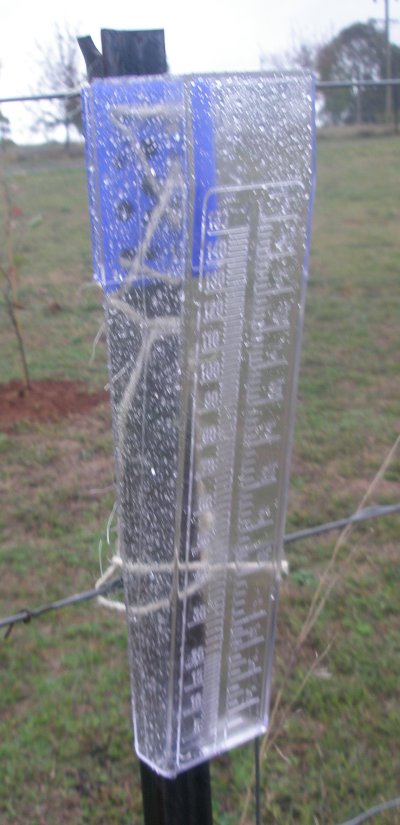
The first year at my job, I felt quite left out of the daily morning conversation; as we did not have a rain gauge. Not only do they discuss the weather, they measure it and compare notes! And it was not just my colleagues, the weather reports repeatedly reiterated how many days it had been since certain places had seen rainfall and they report on dam levels. Now this was something of a foreign concept. But having spent 6 years living in this climate and experiencing weather that I find difficult to explain, I understand and even participate in the daily data collection. And intend to document it though this blog, as it does affect our daily lives. Since we are now solely reliant upon sourcing our own water; as we do not have a mains supply. So our water either comes from rainfall or bore water .
Bore water is water pumped from the ground through a drilled source- much like a well. Many locals have a preference to either rain water or bore water, some refusing to use either/ or, for their own various reasons. Bore water can be ‘hard’ or have other traits dependent upon the ground from which it’s sourced. Here we are fortunate that our ground has high clay content, therefore the water in soft and well filtered. But as rainfall is a naturally available source, you can understand why we aim to collect it when its available.
Rainfall in the tropics is minimal during the “dry season” maybe 10-20mm each month. Which would equate to 400-800 litres in our tanks. And then there is the “wet season”. In the UK we experience 4 seasons; Spring, Summer, Autumn and Winter, in the tropics these are merely a formality, as they have a have a wet season potentially runs from November til May. Involving high average day (and night time) temperatures, high humidity (sometimes even 100%) and RAIN. The dry season falls over winter, with cooler day (and night) temperatures (that we in the UK would think were summer) and dry, sunny days… and a lot of brown vegetation.
| In need to rain- dry season |
I do find it strange that most Australians think of the UK as wet, dark and grey. Not understanding that we do (occasionally) have a summer, with nice weather. And that they have more annual rain than we could even comprehend.
| Christmas/New Year 2011 |
Growing up in Wales (one of the wettest parts of the UK) I thought I understood rainfall. However I tried to prepare my family for the rains, prior to their first visit. They came over Christmas (as they are again this year), which is typically the beginning of the wet season. Although it officially begins in November, since we have been here the rain has begun around Christmas to New year.
These early rainfalls can appear as quickly as they go. One minute there will be clear blue skies, the next can only be compared to having a bucket thrown over your head. Now many would consider this idea pleasant (ourselves included), at least it was still sunny… how naive. The rain merely increases the humidity levels, offering no relief from the heat- Ask my mother! And they left before the real wet hit.
February, we have seen constant monsoon rains that last a few weeks straight. Regularly resulting in roads and communities being cut off for days or even weeks. Luckily being on the coast, we generally only see certain routes cut off for short periods (hours rather than days). But the results can still be devastating. 2008 we witnessed an historic flood, that saw many lower lying areas flood (many that had been there for decades and have never been wet). Locals reported rainfall of up to 850mm (that’s almost 3 feet) in 6 hours- from their rain gauges (mine only goes up to 150mm).
More concerning is that this warm, wet weather also bring with it cyclones. So far we have seen 5, of varying strengths. Well there has been far more than that each year, most do not see land fall, or many have crossed along various other parts of the coast. But we have been on alert and seen 5 come and go. Last year being the worst with Ului crossing us directly and Yasi (the biggest storm ever seen- a category 5!) crossing North of us.
These cyclones are systems that build in the warmer waters (feeding off its energy) and a few each year (Australia wide), cross land. Bringing with it high winds, rain and a lot of damage. I believe they are similar to that of the hurricanes experienced in the Northern hemisphere- as with those that cross USA, but cyclones rotate the opposite direction… much like that water going down the drain ;)
So I guess when I say we had rain last night and the gauge read 1mm, this appears insignificant. But I already mentioned that I intend to blog the weather patterns, as this now forms part of our lives and affect how we operate. I’ll try to report on any weekly rainfall or significant events, as I’ll try not to bore you with this information. Such as this week it is predicted that we will have rain until Wednesday. I highly doubt that this will be significant enough to prevent us having to top up the tanks with the bore. So I wouldn’t warrant a daily update, but at this time of year ever little counts and hopefully the garden will look greener for it.
Tuesday, October 23, 2012
Make it possible... a world without factory farming
http://youtu.be/fM6V6lq_p0o
Anyone who knows us, would be aware that animal welfare and an understanding of where your food comes from and how it is produced is something we strongly believe in. And have openly supported such campaigns in the past (see Food for thought page) and we try to practice what we preach in terms of animal welfare. And what we do usually brings up the conversations of what I call 'meateaters responsiblity'.
Now, I have never believed in ramming our belief down others throats, but I would as you to consider where the produce you buy has come from? And how did it get there?
Now I know its not always possible, and budgets have alot to do with purchase choices. I mean I'm guilty of it myself on occasion; something I am not proud of. But in not buying factory farmed meat some/ most of the time, reduces demand and increases demand for better conditions. Then I don't see that as a bad thing.
Now I know there are those who view meat consumption as the problem, full stop. And many beieve free range to be too expensive. But what I am asking is that you (please) take the time to watch the video and consider the changes and difference you CAN amke.
Then if your interested in making a pledge, and making a difference visit www.makeitpossible.com
http://youtu.be/fM6V6lq_p0o
Anyone who knows us, would be aware that animal welfare and an understanding of where your food comes from and how it is produced is something we strongly believe in. And have openly supported such campaigns in the past (see Food for thought page) and we try to practice what we preach in terms of animal welfare. And what we do usually brings up the conversations of what I call 'meateaters responsiblity'.
Now, I have never believed in ramming our belief down others throats, but I would as you to consider where the produce you buy has come from? And how did it get there?
Now I know its not always possible, and budgets have alot to do with purchase choices. I mean I'm guilty of it myself on occasion; something I am not proud of. But in not buying factory farmed meat some/ most of the time, reduces demand and increases demand for better conditions. Then I don't see that as a bad thing.
Now I know there are those who view meat consumption as the problem, full stop. And many beieve free range to be too expensive. But what I am asking is that you (please) take the time to watch the video and consider the changes and difference you CAN amke.
Then if your interested in making a pledge, and making a difference visit www.makeitpossible.com
http://youtu.be/fM6V6lq_p0o
Monday, October 22, 2012
Egg bound chook
This was a first for us... When I first saw this old girls back end I was most alarmed, but funnily enough I knew exactly what it was.
Matt thought it was something else, as it did seem quite servere. Although I did consider, maybe she had a prolapse- possibly due to age. As we have only had a few eggs from our 3 Indian Game hens for a few weeks. But google confirmed, she was most likely egg bound.
Egg bound birds, tend to be a result or worm infestation- which was unlikely as they were recently wormed (but they will be again shortly-just in case), genetics or age. The latter 2 being more likely for this hen. But it is when the bird can no pass an egg. This can result in death within 48 hours.
Now this was the second morningy, it looks extreme. But I video'd her to confirm. The bit poking out, is from her pushing so hard. The white/creamy liquid is her urine trying the pass the egg.
Now there were a few conflicting reports as to what you shoudl or shouldn't do. Some advising the only real option was to remove the egg manually. Other saying this was an absolute NO, NO.
As she is a flightly bird (to be honest, they are a flightly breed). So I figured handling could only make it worse and she would have been a high risk for egg breakage. And therefore possible infections.
So we resorted to making her as warm and comfortable as possible. I also read that warm water could also assist in relaxing the area. So I was prepared to catch her and place her in a warm bath, as time was now ticking on. Matt had approached the subject of whether it would be better for her or, as an older bird it would be more stress orpain. Which our interference could cause her death anyway. So maybe she would have been better, being put out of her misery. Having already lost a bird that day I was over awred by the suggestion, but had to admit it was a reallistic option.
However an hour after this video, she passed the egg and was happily sctraching around the run again.
This little pig... and a deer?
Well as our ‘freezer pig’ (bought in February to fill our freezer whilst we awaited piglets from our breeding stock) or ‘Christmas ham’, as she is known, is looking more and more likely to be carrying a litter. Matt and a friend bought a pig each from a local piggery.
| 'Christmas Ham'/ 'Freezer Pig'- Berkshirex Saddleback As a weaner- Feb '12 |
Now his friend is not a fan of our ‘slow growing,’ free ranging pigs (or of the quality of Berkshire meat) and swears by these commercially reared, fast growing varieties. And is a big fan of the stock raised by this local piggery. Therefore as we will not be in a position to consume our own, we joined him in purchasing (and supporting) as local businesses.
| Christmas Ham, Smokey (our Berkshire bore) & Streaky (gilt) |
They are duroc and landrace producers. And the animals are mainly raised indoors, something I do wouldn’t want for my pigs. But my Berkshires do not burn in the sun either, and at least these pigs have room and company, unlike many that reach our plates. Guess these are the compromises of commercial production.
Now don’t get me wrong, I am not criticizing his methods. As he is a very experienced and his pigs are all healthy and appear content- though far less active or inquisitive than ours. And at the end of the day, we are still relatively new to this. I have to admit I did warm to him more when he was discussing our pigs with Matt. He said he loved Berkshires and that there was no comparison in the quality of meat. And that he wanted to raise Berkshires when he first started out- only there was no market for them and ended up raising ‘pink pigs’ as that was, what was wanted.
I have to admit, he has been running this place for a number of years. So his story of raising ‘pink pigs’- fast growing, high production meat is common throughout the 1980’s and 90’s. As a result a lot of ‘heritage breeds’ such as the Berkshire, that do not do well in these more intensive conditions became less common, to the point where they have been listed as 'rare' on the Rare Breeds registers www.rbta.org/pigs.htm https://www.rbst.org.uk
Now don’t get me wrong, this guy is commercial, but by no means cruel- there are pigs reared in far worse conditions out there. His are clean, healthy and have space and company... more than many, but I’m not here to lecture on that- least not today, just can’t help but get distracted on the subject.
So Friday evening the boys returned with a pig each and (unexpectedly) a deer each. The deer belong to the owner of the piggery. I wouldn’t say they are reared, or farmed, but they are there. They have had a deer from him in the past, but these were ‘freebies’ as they were providing a service. They had escaped and were causing damage (and hostility) for the neighbour. So these exceptionally well fed deer (courtesy of the neighbour paddock and house yard) made an much appreciated addition.
Now Matt’s friend is not a believer in eating offal. In his opinion (which he has voiced to me numerous times) why eat it when there are perfectly good meat on a beast. I on the other hand believe if you are to take a life, then you do the animal justice and use as much as possible. Unfortunately for me, I don’t actually like all offal, liver in particular. Now it has nothing to do with what it is, as it was always a favourite of my grandparents. And I love the smell; it smells delicious! I don’t know if it brings back fond memories, but I salivate whenever I cook it for Matt… I just wish I liked the taste!
But his loss Is our gain! So Matt spent yesterday making batches of pate (something I will eat). So he used both the pigs livers and the venison livers- this will be a first for either of us. So am looking forward to reporting on the tasting.
And then last night, after leaving them hang, they processed the cuts. It took about 4 hours for all 4 beasts. So tonight I go back with him to bag and tag… Then stock up the freezer.
Subscribe to:
Posts (Atom)